公元208年,东汉末年,曹操统一北方后挥师南下,意图一举吞并江东的孙权与依附而来的刘备。孙刘联军兵力远远少于曹操大军,双方在长江赤壁一带(今湖北赤壁市西北)对峙。这场战役被陈寿写进了《三国志》,是真实发生过的历史事件,并非全是小说家言。
In 208 CE, near the end of the Han Dynasty, Cao Cao unified the north and led his army south, intending to conquer Sun Quan of the southeast and Liu Bei, who had allied with him. The Sun-Liu allied forces were far outnumbered by Cao Cao's army, and the two sides faced off along the Yangtze River near Red Cliffs, in present-day northwest Chibi, Hubei. This battle was recorded by Chen Shou in the official history Records of the Three Kingdoms, so it is a real historical event, not purely a novelist's invention.
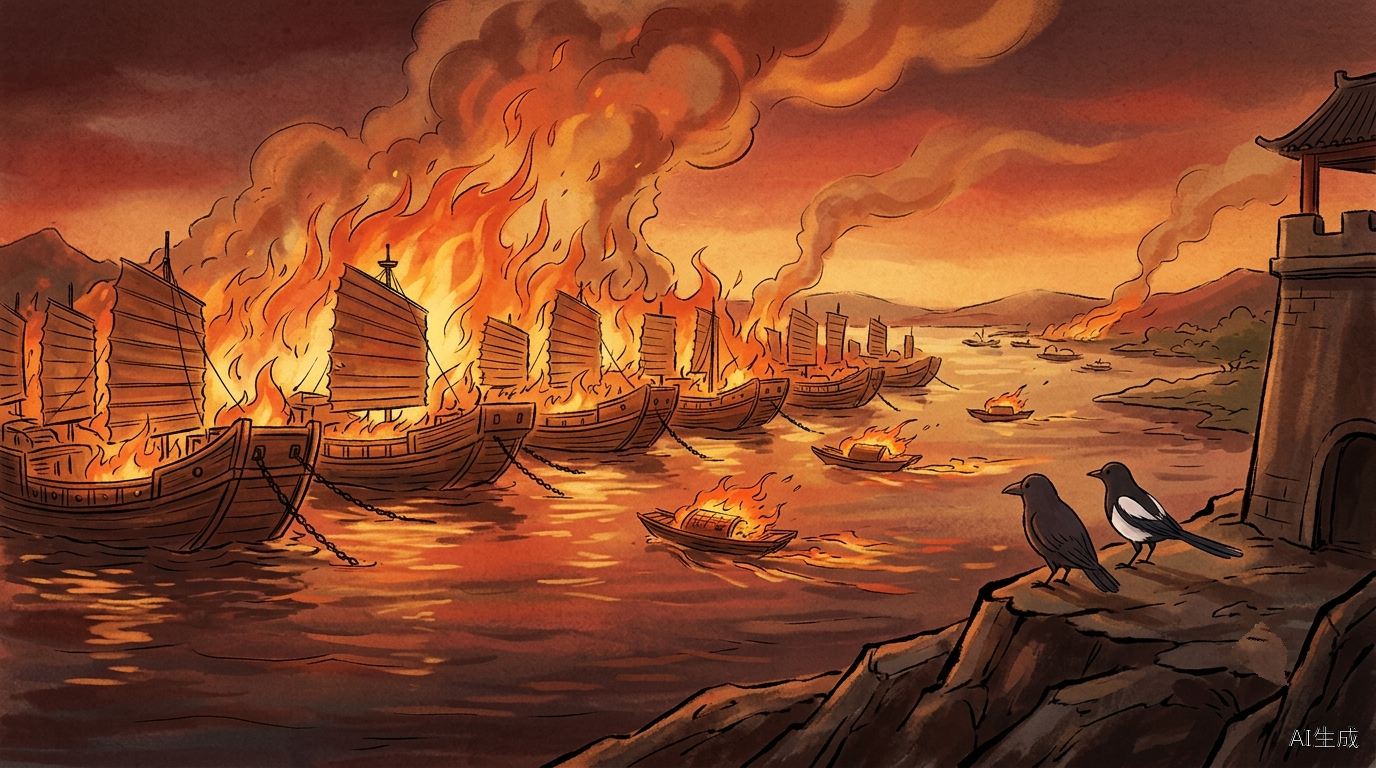
东吴将领黄盖献上火攻之计,先诈称投降接近曹军战船。曹操因北方士兵不习水战,将战船首尾用铁索连接以减少摇晃,谁知这反倒成了火攻的天然弱点。趁着东南风起,黄盖的船队点火冲向曹军连船,大火迅速蔓延,曹操大军溃败北撤,此战直接促成了后来魏蜀吴三国鼎立的格局。
Huang Gai, a general of the Eastern Wu, proposed a fire attack strategy, first faking surrender to get close to Cao Cao's warships. Because his northern soldiers were unfamiliar with naval warfare, Cao Cao had chained his ships together bow to stern to reduce rocking, but this ended up becoming the fatal weakness the fire attack exploited. When the southeast wind rose, Huang Gai's fleet set fire and charged into Cao Cao's chained ships, the flames spread rapidly, and Cao Cao's army collapsed and retreated north. This battle directly led to the later Three Kingdoms standoff between Wei, Shu, and Wu.
🔥 号称百万雄师,却在长江上被一把火烧得溃不成军——
当阿鸦讲起这场三国最经典的以少胜多之战,小喜才明白,真正的智慧,往往比兵力更致命。
付费解锁完整故事 · 火烧赤壁 · 趣味词卡
🔒 后续内容已锁定
一次付费解锁完整故事 · 情景对话 · 趣味词卡 · 1年时效
小喜盯着图片里那一片连在一起的战船,好奇地问,"阿鸦,这些船怎么全部绑在一起呀?看起来乱糟糟的。"
Magpie stared at the picture of warships all chained together, curious. "A-Ya, why are all these ships tied to each other? It looks like a mess."
阿鸦难得眼睛发亮,"这可是三国里最有名的一场硬仗——曹操号称八十万大军,结果却栽在了一把火上。"
A-Ya's eyes lit up, rare for him. "This is one of the most famous battles in the Three Kingdoms period, Cao Cao claimed to have eight hundred thousand troops, and yet he was brought down by a single fire."
小喜瞪大了眼睛,"八十万?!那后来到底发生了什么呀?"
Magpie's eyes went wide. "Eight hundred thousand?! So what actually happened after that?"
小喜追问,"那么多兵,怎么会输呢?"
Magpie pressed, "With that many troops, how could they lose?"
阿鸦意味深长地说,"打败他的不是敌人,是自己人的傲慢。"
A-Ya said meaningfully, "What defeated him wasn't the enemy — it was his own side's arrogance."
小喜若有所思,"那曹操这么厉害的人,怎么会没想到这个破绽呢?"阿鸦沉默了一下,"每个人都有想不到的地方,尤其是当你觉得自己已经稳赢的时候。这场大火烧掉的不只是曹操的战船,也烧出了后来魏蜀吴三分天下的局面。真正决定胜负的,从来不是兵力多少,而是有没有人看得清局势里的破绽。"
Magpie thought for a moment, "But Cao Cao was so capable, how could he not have noticed this flaw?" A-Ya was quiet for a moment, "Everyone has blind spots, especially when you already believe you have won. That fire did not just burn Cao Cao's ships, it also burned the old order away and gave rise to the later three-way split of the realm into Wei, Shu, and Wu. What truly decides victory is never the size of an army, but whether someone can see the flaw hidden in the situation."
有趣的是,"诸葛亮借东风"这个广为流传的桥段——在祭坛上作法、七星旗招来东南风——其实是后来小说三国演义里的艺术加工。真实的历史记载里,东南风只是当时长江一带常见的自然天气,是周瑜和黄盖抓住了这个天时,并没有任何做法求风的情节。🔥🐦
Interestingly, the widely known scene of "Zhuge Liang summoning the east wind," performing a ritual on an altar with banners to call forth a southeast wind, is actually a dramatic invention from the later novel Romance of the Three Kingdoms. In the real historical records, the southeast wind was simply common natural weather along the Yangtze River at that time of year, and it was Zhou Yu and Huang Gai who seized this opportunity, there was no ritual involved at all.
支付以下动态金额(基准¥3,浮动±0.5)