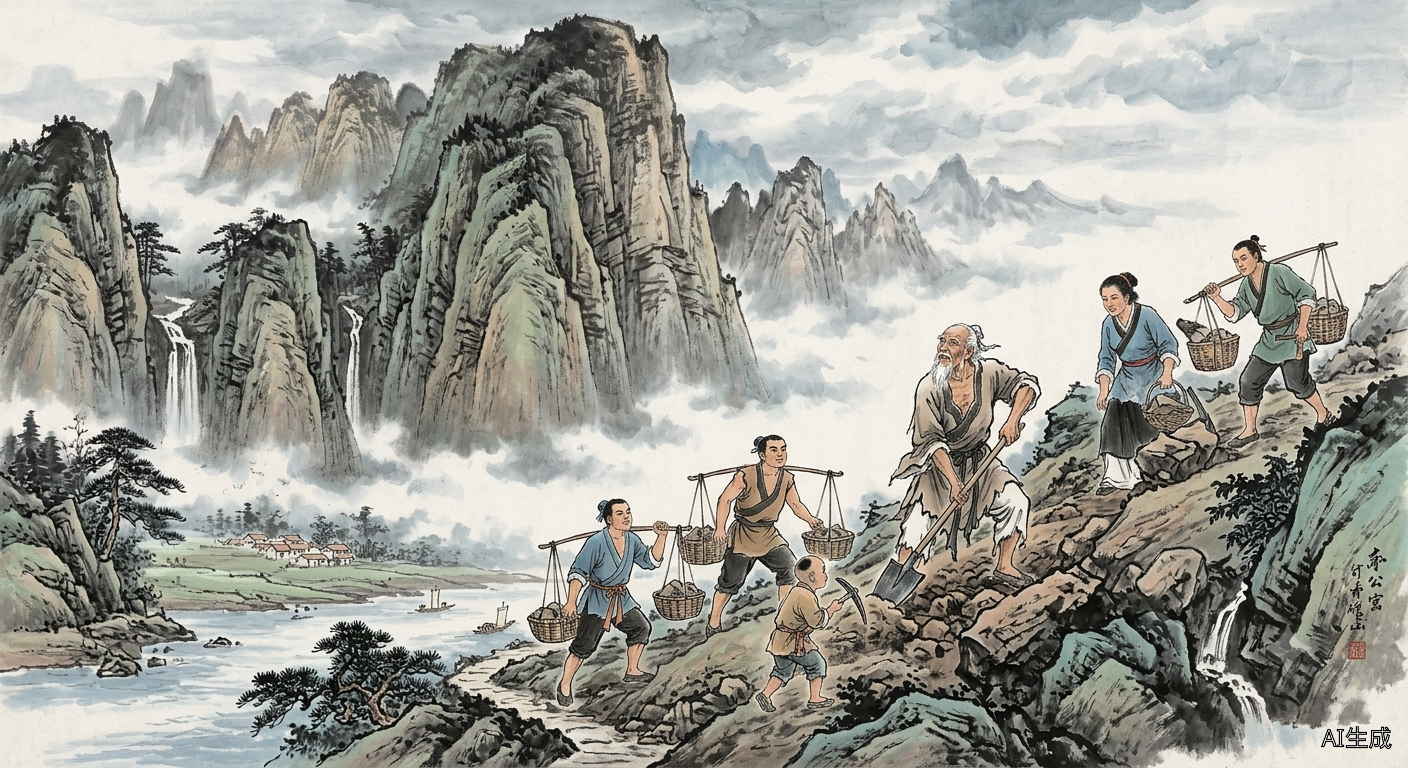
愚公移山的故事记载在《列子·汤问》里,是中国古代最有名的寓言之一。传说太行、王屋两座大山,方圆七百里、高万仞,正好挡在愚公家门前,出门进门都要绕远路。愚公已经九十岁了,他把家人召集起来商量:"我想和大家一起把这两座大山铲平,开出一条直通豫南的路,你们说好不好?"
The story of Yu Gong Moving Mountains is recorded in the "Tang Wen" chapter of the Liezi, one of ancient China's most famous fables. Legend says two great mountains, Taihang and Wangwu, stood right in front of an old man's door, forcing him to take a long detour every time he went in or out. Yu Gong was already ninety years old when he gathered his family and said, "I want us to level these two mountains together and open a straight road south — what do you think?"
家人们都表示赞成,只有妻子担心地问:"以您的力气,连魁父那样的小山丘都动不了,又怎么撼动得了太行、王屋呢?况且挖出来的土石往哪里放?"愚公说:"可以扔到渤海边上去。"于是第二天,愚公就带着子孙们,扛起锄头,开始凿石挖土。
His family all agreed, but his wife asked worriedly, "With your strength, you couldn't even move a small hill like Kuifu — how could you possibly move Taihang and Wangwu? And where would you even put all that dug-up earth and rock?" Yu Gong replied, "We could dump it by the Bohai Sea." So the very next day, Yu Gong and his sons and grandsons picked up their hoes and began breaking rock and digging earth.
🏺 一场惊天动地的搏斗,让两个陌生人成了挚友——
可天神的惩罚,却让这段友情走向了谁也没料到的结局……
付费解锁完整故事 · 永生的追寻 · 趣味词卡
🔒 后续内容已锁定
一次付费解锁完整故事 · 情景对话 · 趣味词卡 · 1年时效
小喜看着画里两座巍峨的高山,正好挡在一户人家门前,好奇地问:"阿鸦,这两座大山挡在门口,这户人家出门可怎么办呀?"
Magpie looked at the painting of two towering mountains blocking a family's front door, and asked curiously, "A-Ya, with these two mountains blocking the doorway, how does this family even get out?"
阿鸦说:"这户人家的主人叫愚公,已经九十岁了。他决定做一件谁都想不到的事——把这两座大山搬走。"
A-Ya said, "The man who lives there is called Yu Gong, already ninety years old. He decided to do something no one expected — move both mountains away."
小喜惊讶:"九十岁的老人,要搬两座大山?这怎么可能呀?"
Magpie was amazed, "A ninety-year-old man, moving two mountains? How is that even possible?"
阿鸦说:"这正是这个故事最让人意外的地方。"
A-Ya said, "That's exactly the most surprising part of this story."
小喜追问:"怎么意外?"
Magpie pressed on. "Surprising how?"
阿鸦说:"村里有个人称智叟的老人听说了,跑来嘲笑愚公,说他连山上的一根草都动不了,何况是两座大山?"
A-Ya said, "A man in the village called Zhi Sou heard about it and came to mock Yu Gong, saying he couldn't even move a blade of grass on the mountain, let alone two whole mountains."
小喜好奇:"愚公听了是不是很生气?"
Magpie was curious, "Did Yu Gong get angry hearing that?"
阿鸦说:"愚公不但没生气,还说了一句流传千年的话,把智叟说得哑口无言……具体说了什么,还得从头讲起。"
A-Ya said, "Yu Gong wasn't angry at all — instead he said something that has been passed down for a thousand years, leaving Zhi Sou speechless... but to find out exactly what he said, we'll have to start from the beginning."
小喜听完,感叹地说:"愚公真的把山搬走了!"阿鸦点点头:"其实愚公心里比谁都清楚,光靠自己这辈子,是挖不平大山的。但他相信,只要一代代人不放弃,总有一天能做成。这个故事流传了两千多年,中国人一直用‘愚公移山’来形容那种明知很难,也绝不放弃的精神。"
Magpie sighed in amazement, "Yu Gong really did move the mountains!" A-Ya nodded. "Actually, Yu Gong knew better than anyone that he alone could never finish leveling the mountains in his lifetime. But he believed that as long as each generation kept trying, it would eventually get done. This story has been told for over two thousand years, and Chinese people still use Yu Gong Moves the Mountains to describe the spirit of never giving up, even when something seems impossible."
愚公移山的故事最早出自战国时期思想家列子所著的《列子·汤问》篇,距今已有两千多年历史。这个故事后来成为中国最广为人知的寓言之一,1945年,毛泽东还专门写过一篇题为《愚公移山》的文章,用这个故事来鼓励人们坚持不懈、团结奋斗。如今,愚公移山这个成语,已经成了中国人形容坚韧不拔精神的代名词。⛰️📜
The story of Yu Gong Moving Mountains first appeared in the Tang Wen chapter of the Liezi, written by the philosopher Liezi during the Warring States period, over two thousand years ago. It later became one of China's most widely known fables. In 1945, Mao Zedong even wrote an essay titled The Foolish Old Man Who Removed the Mountains, using the story to encourage perseverance and collective effort. Today, Yu Gong Moves the Mountains has become a Chinese idiom representing unwavering determination.
支付以下动态金额(基准¥3,浮动±0.5)